Founder
Founder
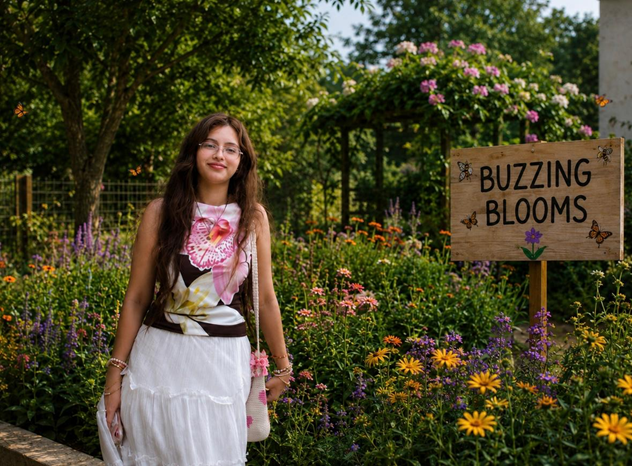
My name is Gunisha Kaur, a student environmentalist whose work explores the intersection of ecology, psychology and inclusive design.
The first time I watched a child become absorbed in a pollinator garden, I was paying attention to the bees. By the time I looked up, I realised something else was happening. The garden was changing the child too.
That moment stayed with me. It planted a question that would eventually become Buzzing Blooms: could the same spaces that help pollinators thrive also create belonging for people?
Growing up in Ludhiana, a city transformed by rapid industrialisation, I watched the gradual disappearance of the bees and butterflies that had fascinated me since childhood. At first, it felt like a small change, but over time I realised it reflected something much larger. The decline of pollinators was not merely an ecological issue; it was a sign of a growing disconnect between people and the natural systems that sustain life. That realisation stayed with me and eventually became the foundation of Buzzing Blooms.
At the same time, my experiences with my younger brother, who is on the autism spectrum, taught me how deeply environments shape behaviour, learning, and belonging. I often noticed that in green spaces he appeared calmer, more engaged, and more comfortable. Nature seemed to create opportunities for connection that many conventional environments could not. Those observations made me wonder whether the same spaces that support biodiversity could also support human wellbeing.
Sustainability was also a value nurtured throughout my school years. Through environmental initiatives, community service activities and experiences working with children from diverse backgrounds, I learned that meaningful change often begins with small, consistent actions. These experiences encouraged me to see environmental stewardship not as a separate responsibility but as part of everyday life.
At the time, these experiences felt unrelated—a disappearing butterfly, a quiet moment in a garden with my brother, a plantation drive, a conversation with a child. It was only later that I realised they were all pointing toward the same idea: the wellbeing of people and the wellbeing of nature are deeply interconnected.
On 5 March 2023, at the age of fourteen, I planted my first pollinator garden in our backyard. I did not begin with a blueprint, a funding plan or even the certainty that it would work. I simply wanted to create a small refuge for bees, butterflies and other pollinators. Yet as that garden grew, so did my understanding of its impact.
When Buzzing Blooms expanded into schools, juvenile homes, orphanages, blind schools and community spaces, I began to notice something remarkable. The gardens were attracting pollinators but they were also creating environments where children felt comfortable, curious and included. Neurodivergent children engaged with sensory-rich natural spaces. Underprivileged children discovered opportunities to learn and lead. Communities that rarely interacted found common ground through planting and caring for living spaces together.
That was when I realised that these gardens were doing more than restoring biodiversity. They were creating belonging.
The gardens were easier to plant than the partnerships required to sustain them.
At fourteen, I quickly learned that enthusiasm alone rarely opens doors. Proposals required approvals, opportunities depended on partnerships and credibility often had to be earned before the work could begin. Learning to collaborate with educators, psychologists, environmental organisations, community leaders and government-supported institutions became an essential part of the journey. Those partnerships ultimately helped Buzzing Blooms grow far beyond what I could have achieved alone.
Today, Buzzing Blooms has grown into a network of more than twenty pollinator gardens and ecological restoration initiatives across Ludhiana, Meerut, Mumbai, and partner communities. Through workshops, restoration drives, ambassador-led projects, and inclusive learning programmes, the initiative has engaged over 4,000 students, included more than 250 neurodivergent and vulnerable individuals, and extended its impact to more than 8,000 individuals across communities. Through the Ambassador Program, students have adapted and replicated the model within their own communities, allowing the idea to grow far beyond the gardens I personally created.
The journey behind Buzzing Blooms has been deeply interdisciplinary. Before founding the initiative, I was an active member of EcoAas, the environmental wing of Aas Ehsaas, where I participated in environmental awareness campaigns and large-scale plantation drives across my community. Around the same time, I began training at Divyam Mind Guiding Academy to better understand and support my younger brother. What started as a personal effort evolved into a long-term commitment, and I continue to work with neurodivergent children across the psychology and special education departments under the guidance of psychologists and special educators. Through therapeutic activities, behavioural observation, classroom support and inclusive learning programmes, I have gained practical experience in understanding diverse learning needs and creating supportive environments.
Alongside this, I have continued to pursue learning in psychology and mental health through programmes and internships under Dr. Bhawna Barmi, an internationally recognised clinical psychologist and founder of Happiness Studio. I further strengthened my understanding of psychology through training and internship programmes conducted by Fortis Healthcare focussing on emotional wellbeing, life skills and mental health awareness while also undertaking training in art therapy and expressive arts-based approaches. Together, these experiences strengthened my understanding that environmental and social challenges are deeply interconnected and helped shape Buzzing Blooms into a model that supports both biodiversity and human wellbeing.
My curiosity about human behaviour led me to pursue further learning in psychology, philosophy, and neuroscience under the mentorship of Dr. Esther Rosario of Dartmouth College. I also developed AeroBloom under the mentorship of Dr. Reenu Jain, inspired by a challenge I repeatedly observed in the field. The more time I spent monitoring pollinator activity, the more I noticed a pattern. Even in restored pollinator gardens, periods of extreme heat and seasonal climatic stress could dramatically reduce pollinator visits. Restoring habitat was important but what happened when environmental conditions temporarily made those habitats difficult to use? Seeking to address this gap led to the development of AeroBloom, an innovation designed to support natural pollinators during ecological stress periods. Through both research and practice, I have become increasingly interested in how ecological restoration can nurture healthier ecosystems and healthier communities together.
I am also a passionate reader and writer. My work explores psychology, behaviour, environment, and cognition and has received international recognition through the Harvard International Review Academic Writing Contest, the Queen’s Commonwealth Essay Competition, and the Immerse Education Essay Competition. I have had the honour of representing India at the World Scholar’s Cup Tournament of Champions at Yale University, serving as India’s Flag Bearer during the global awards ceremony and receiving honours in debate and collaborative scholarship. My research, including an in-depth study of the impact of pollinator gardens on neurodivergent children, has been presented and published internationally.
To expand the reach of Buzzing Blooms, I created the Buzzing Blooms Ambassador Program and authored educational resources, including Buzzing Blooms and The Gardens That Heal, which encourage young people to engage with environmental stewardship, inclusive design and nature-based learning. I am also a Core Team Member and Content Lead at Feminaa, a youth-led initiative focused on women’s empowerment and social awareness, where I create content for campaigns, workshops, events and social media outreach. My commitment to systems-level change inspired me to develop the Living Schools Proposal, a framework that integrates biodiversity-focused design into inclusive education. This work was further shaped through the Young SDG Leaders Programme under the guidance of InnovaPolis, where I explored sustainability, design thinking, and social innovation.
Over the years, the ideas, research and initiatives that have shaped my journey have received recognition from organisations including the India Book of Records, Kalam’s World Records, the Indian Science and Engineering Fair (INSEF), the Learning Planet Youth Design Challenge, and the Punjab State Commission for Protection of Child Rights.
Yet the most meaningful moments are not the awards.
They are the moments when a child plants a seed for the first time, when a butterfly returns to a restored habitat, or when a community comes together around a shared purpose. I often think back to those early moments with my brother in the garden—the quiet calm, the curiosity, and the sense of connection that nature seemed to create so effortlessly.
As I often say, these gardens do not belong to me. They belong to the children, the pollinators, and the people who care for them.
Behind every pollinator garden, every child planting a seed, and every restored patch of land is a belief that continues to guide my work: that healing, inclusion, and hope often begin with the smallest living things. Sometimes they begin with a flower. Sometimes with a bee. Sometimes with a child discovering that they belong.
My experience of growing up alongside her younger brother, who is on the autism spectrum, revealed how deeply environments shape behaviour and belonging. She witnessed the calming effect of structured green spaces, but also the social exclusion neurodivergent children often face in conventional settings. In nature, she observed something different: greater calm, focus, engagement and ease of interaction. These insights later informed the inclusive design of her work.
At 14, she started with a single pollinator garden in her backyard on March 5, 2023. As the initiative expanded into schools, juvenile homes, orphanages, blind schools and community spaces, a deeper pattern emerged—these spaces were not only restoring pollinator activity but also creating environments where neurodivergent and underprivileged children felt engaged, comfortable and included.
The initiative gradually evolved into a dual-impact model—restoring biodiversity while enabling inclusive, nature-based learning.
To date, Buzzing Blooms has established 18 primary pollinator gardens across Ludhiana, Meerut and Mumbai. Through the Ambassador Program, the model has also been adapted and replicated by students in their own communities.
Behind this growth is deep interdisciplinary preparation. Gunisha spent four years learning ecological restoration under environmental mentors and studying pollinator ecology through independent research and field observation. Alongside this, she completed a four-year internship at Divyam Mind Guiding Academy, training under psychologists in therapeutic programmes for children with special needs.
Alongside her fieldwork, Gunisha pursued interdisciplinary learning in psychology, philosophy and neuroscience under the mentorship of Dr. Esther Rosario of Dartmouth College. She further developed AeroBloom, an innovation designed to support natural pollinators during periods of ecological stress under the mentorship of Dr. Reenu Jain.
Gunisha is a committed reader and disciplined writer whose work explores psychology, behaviour, environment and cognition. Her writing has received international recognition, including distinctions from the Harvard International Review Academic Writing Contest, Queen’s Commonwealth Essay Competition and the Immerse Education Essay Competition.
She has also represented India at the World Scholar’s Cup Tournament of Champions at Yale University, where she was selected as the Flag Bearer for India during the global awards ceremony and received multiple honours in debate and collaborative scholarship. Her research on pollinator gardens and neurodivergent children has been presented and published internationally.
To scale the model, Gunisha created the Buzzing Blooms Ambassador Program and authored youth-focused educational resources including Buzzing Blooms and The Gardens That Heal exploring environmental stewardship, inclusive design and nature-based learning.
She is also the co-founder of Feminaa, a youth-led initiative focused on women’s empowerment and social awareness. She also wrote the Living Schools Proposal, a policy framework that integrates biodiversity-focused design into inclusive education. Her policy work on the Living Schools Proposal was shaped through the Young SDG
Leaders Programme under the guidance of InnovaPolis, where she explored design thinking, sustainability and systems-level social innovation.
What began as a backyard experiment in Ludhiana has evolved into a collaborative model spanning multiple cities. Today, Buzzing Blooms operates as both a grassroots restoration initiative and a living research model. Gunisha continues to guide its research vision and strategy, while a growing team carries the work forward across communities.
Her interdisciplinary work has received recognition across international research and innovation platforms, including INSEF, the Learning Planet Youth Design Challenge, the India Book of Records, Kalam’s World Records and the Punjab State Commission for Protection of Child Rights.
As she says, They belong to the children, the pollinators and the teams who tend them
Behind every pollinator garden, every child planting a seed and every restored patch of land is a deeper belief — that healing and hope often begin with the smallest living things.
This reflection was written as a personal expression of the vision behind Buzzing Blooms.
The Garden That Remembers Wings.
This didn’t start in a speech or a summit.
It started in a quiet backyard in Ludhiana,
where mornings once arrived quietly—
flowers blooming without footsteps beside them,
bees disappearing before anyone learned their names.
I watched a butterfly circle a dying marigold
like it was searching for a home already erased,
and I could not unsee it.
So, I planted.
Not a garden for perfection,
not a garden trimmed into silence,
but a wild sanctuary—
lantana spilling over fences,
milkweed trembling in afternoon heat,
sunflowers lifting their faces
like prayers that refused to bend.
I planted for my brother,
who hears the world too sharply,
who finds chaos in a touch.
In the garden’s structured air,
he could breathe slower.
So, I built for him
a place where the world agrees with itself:
saffron corners for calm observation,
indigo pathways for quiet retreat,
green centres where hands can touch
only what is safe—
unthorned, non-toxic, gentle—
where a bee is not a fear but a teacher,
marked, explained, respected.
I kept building.
That small Ludhiana backyard became a city
of winged returnees:
carpenter bees heavy as velvet,
fireflies stitching dusk with cold fire.
Then we carried this into the world—
to Dugri Park’s dull green patch,
to the forgotten clay of a juvenile home,
to the blind school where a girl
learned the shape of a marigold
by the vibration of a pollinator’s hum
against her palm.
In the State Care Centre,
where hard stories are held,
we healed a blight of dirt
into a breathing, buzzing sanctuary.
At Sahyog Halfway Home,
we painted pots with our hands
and planted hope in colors
the children named themselves.
In the orphanage garden,
a child who has never planted anything
waters a seedling and says,
“I am taking care of this life,”
and I know the ecosystem is now inside her.
Still—
the heat keeps rising.
Concrete keeps spreading.
Forests keep thinning into memories.
People still spray poison into the mouths of flowers
and wonder why spring sounds quieter.
But in every Buzzing Blooms garden,
there is a rebellion rooted in nectar.
Because when a child plant zinnia
in the soil of Ludhiana,
when an abandoned corner blooms again,
when communities measure wealth
not in towers but in birdsong—
the future shifts,
even if only slightly.
Buzzing Blooms taught me
that change does not always arrive loudly.
Sometimes it lands softly on the back of a bee.
Sometimes it begins with one person
kneeling in the dirt in a small backyard,
near a village called Sangowal,
believing a patch of earth is still worth saving.
And maybe that is how healing starts—
not all at once,
not everywhere,
but garden by garden,
flower by flower,
wing by wing.
Because planting a seed
is a revolutionary act.
And the little things—
the safe corner, the unthorned leaf,
the color-coded path,
the child who finally speaks to a bee—
these will make the biggest changes
in the future we are building together.
-Gunisha